
While GCC countries generally do not impose inheritance or estate taxes, families holding assets abroad may face significant tax liabilities. UK property, U.S. equities, and French real estate for example, can create inheritance or estate tax exposure, regardless of the family's country of residence.
Understanding inheritance and estate tax rules across different jurisdictions is therefore essential to effective cross-border estate planning.
The UK: Inheritance Tax and Residence-Based Rules
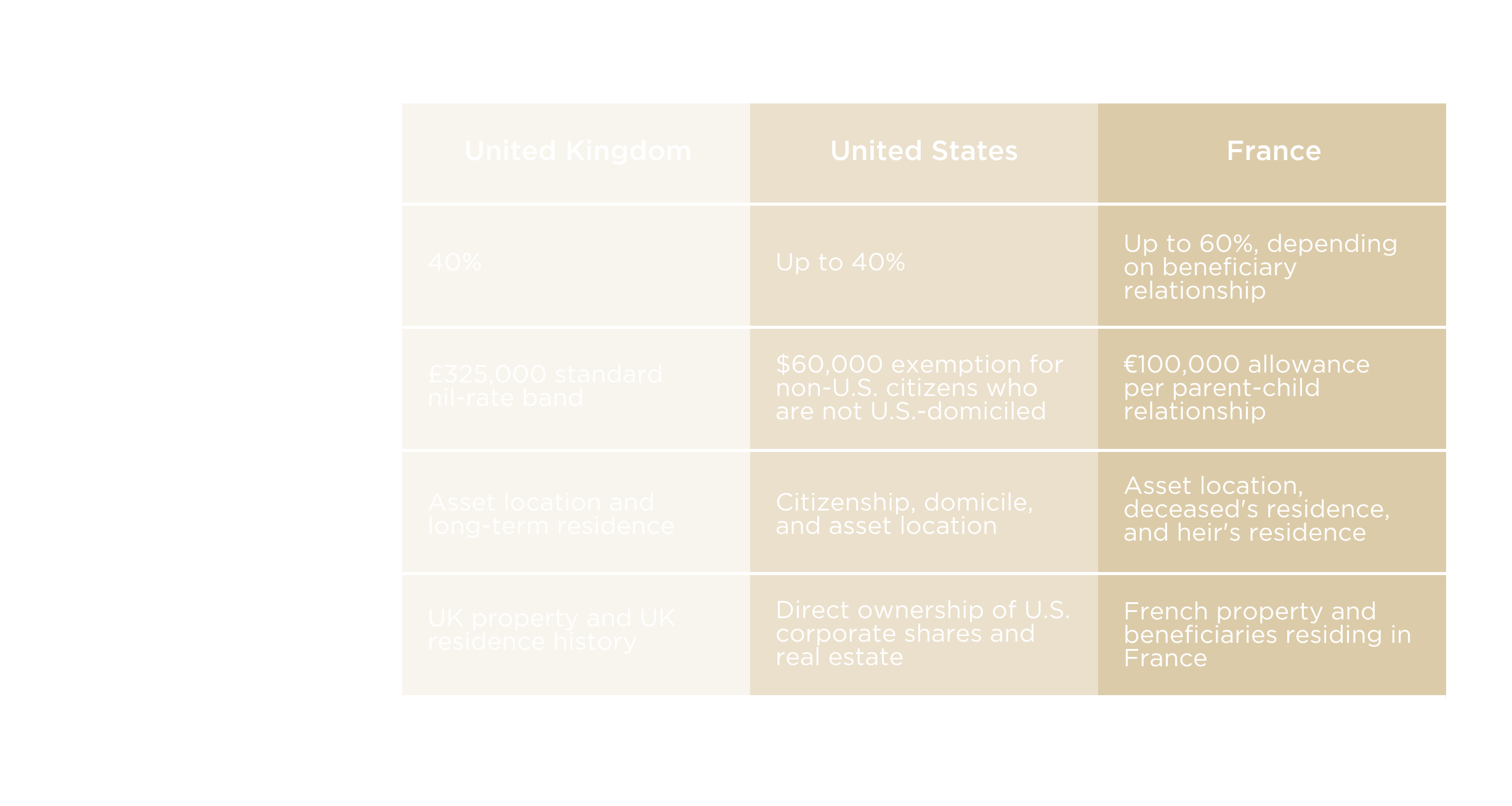
The UK generally imposes a 40% inheritance tax on the portion of an estate exceeding the £325,000 nil-rate band.[1] An additional residence nil-rate band of up to £175,000 may apply when a qualifying home passes to direct descendants, subject to eligibility conditions.[2]
A significant change introduced in April 2025 replaced the previous domicile-based framework with a residence-based approach. Individuals who meet the long-term UK residence criteria may become subject to inheritance tax on their worldwide assets, rather than only their UK holdings.[3]
This change is particularly relevant to internationally mobile families with substantial UK residence histories, highlighting the importance of reviewing existing estate planning arrangements.
Trusts can also face separate inheritance tax charges, including charges on certain transfers into trusts, periodic charges of up to 6% every 10 years, and exit charges.[4] The applicable treatment depends on the trust structure and circumstances.
The U.S.: Estate Tax Exposure for Non-U.S. Persons
U.S. federal estate tax treatment differs significantly between U.S. citizens or domiciliaries and non-U.S. persons.
For 2026, U.S. citizens and domiciliaries benefit from a federal estate and gift tax exemption of $15 million per individual, subject to applicable rules and future inflation adjustments.[5]
By contrast, non-U.S. citizens who are not domiciled in the U.S. generally have an estate tax exemption of only $60,000[6] on U.S.-situated assets, with progressive tax rates reaching 40%.[7][8]
U.S.-situated assets can include U.S. real estate and shares in U.S. corporations, regardless of where the brokerage account is maintained. However, the treatment of other investments depends on their legal classification.
For example, a non-U.S. individual directly holding $10 million in shares of U.S. corporations could face a substantial federal estate tax liability upon death.
GCC countries do not have estate tax treaties with the U.S. that provide additional relief. Consequently, families holding U.S. investments directly may benefit from reviewing their ownership structures with qualified advisers to assess potential estate tax exposure.
France: Inheritance Tax and the Heir's Residence
French inheritance tax rates generally range from 5% to 45% for transfers to children, with a personal allowance of €100,000 per child, subject to applicable conditions. Rates can reach 60% for certain unrelated beneficiaries.[9]
French inheritance tax may apply to worldwide assets when the deceased was a tax resident of France. For non-resident deceased individuals, taxation generally focuses on French-situated assets.[10]
Importantly, the heir's residence can also create tax exposure. If an heir is a tax resident of France and has been resident in France for at least six of the preceding 10 years, France may tax worldwide assets received through inheritance, subject to applicable treaties and reliefs.[11]
This is particularly relevant for GCC-based families with children or other beneficiaries residing in France, even when the inherited assets are located elsewhere.
Key Considerations for GCC Families
Inheritance and estate tax exposure varies significantly across jurisdictions. While the U.S. focuses on citizenship, domicile, and asset location, the UK considers long-term residence, and France may also consider the heir's residence history.
Families with international assets should therefore review their exposure across jurisdictions rather than relying on a single estate planning structure.
Key considerations include identifying where assets are located, assessing the residence or domicile status of family members, and reviewing whether existing ownership structures remain appropriate.
A coordinated approach involving qualified legal, tax, and estate planning professionals can help families address potential liabilities while supporting long-term wealth preservation and succession objectives.
Conclusion
Although GCC countries generally do not impose inheritance or estate taxes, international investments and family residence arrangements can create significant cross-border tax exposure.
The Family Office, working alongside qualified legal, tax, and estate planning professionals, can support families in reviewing their investment structures and developing diversified portfolios aligned with their long-term wealth preservation objectives.


