
Private credit entered 2026 as one of the fastest-growing areas of finance. It is now facing a more difficult test. Defaults have reached a record level in one widely followed measure, redemption requests are rising at some retail-focused funds, and questions about software borrowers are intensifying as artificial intelligence reshapes their markets.[1]
Yet the picture is not one of broad collapse. The pressure is concentrated in certain areas of the market, while others remain resilient. Major managers continue to report resilient results and institutional demand remains strong.[2]
The Federal Reserve says private credit markets are functioning normally. For investors, the key is to distinguish between the areas facing greater pressure and those that continue to perform well, as pockets of volatility reveal dislocations across the market.[3]
Stress is rising, but it is not evenly distributed
Fitch Ratings reported that its trailing 12-month US private credit default rate reached 6.1% in July 2026, up from 6.0% in June and the highest level in the history of its measure. In the second quarter, Fitch recorded 32 default events involving 20 new borrowers. Industrials and manufacturing had the highest default rate among major sectors at 10.4%, followed by healthcare at 9.4%.[4]
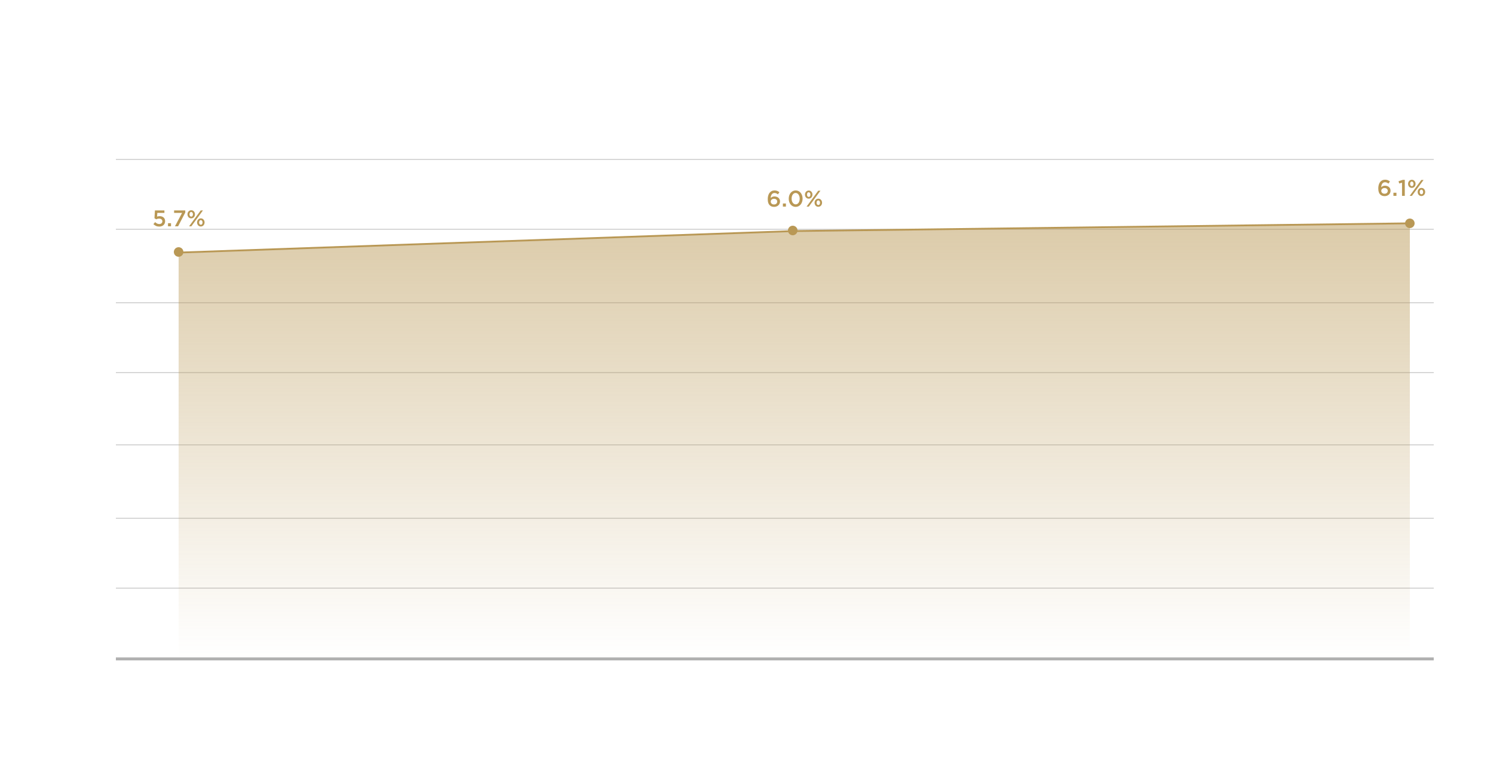
These figures deserve attention, but they do not describe every private credit strategy or manager. There is significant dispersion across the market. Different funds lend to different types of companies, use different levels of leverage and negotiate different protections. Current conditions are beginning to reveal those differences more clearly, with pockets of volatility revealing dislocations across certain areas of the market while others remain resilient.
AI is creating opportunity and pressure
Technology sits at the center of the current debate. The Bank for International Settlements reported that direct-lending funds have quadrupled their exposure to AI and information technology over five years. These sectors now account for approximately 15% of their portfolios.[5]
AI is affecting credit in two directions. The buildout of data centers and computing infrastructure is creating significant demand for financing. At the same time, AI is challenging the business models of some established software companies that borrowed heavily when interest rates were lower.[6]
For lenders, the distinction matters. Financing infrastructure supported by contracted cash flows is different from lending to a software company whose revenue may be disrupted. Both may appear under a broad technology allocation, but their sources of risk are not the same. This is one example of why broad private credit data can mask significant differences between underlying strategies and exposures.
Redemption requests are testing liquidity
Pressure is also appearing at the fund level. During the second quarter, redemption requests reached 38.1% of net asset value at one technology-focused vehicle, 18.9% at another credit fund and 16.8% at a third. Most funds repurchased shares equal to approximately 5% of net asset value, with remaining requests carried forward.[7]

This does not automatically indicate poor underlying investments. It does show the tension that can arise when investors are offered periodic access to funds holding loans that may take years to mature. The growth of the secondary market is another signal: global private credit secondary volume reached $20.4 billion in the first half of 2026, up 122% from a year earlier.[8]
What could turn contained stress into a broader problem?
For now, the Federal Reserve says markets remain orderly. Its July meeting minutes noted that redemption requests continued to rise in the second quarter, but private credit defaults were little changed over the meeting period and credit remained available to most businesses.[9]
Nouriel Roubini reaches a similar conclusion in his August outlook to The Family Office clients. High leverage creates vulnerability, but vulnerability alone does not create a systemic crisis. A wider economic shock that reduces company earnings, weakens cash flow and triggers a recession would be needed to turn isolated credit problems into a broader debt event.
What this means for portfolio construction
Pockets of volatility are revealing dislocations across private credit, making strategy selection, manager selection and portfolio construction more important. A private credit allocation should be assessed alongside the investor's existing exposure to private equity, technology, real estate and other illiquid assets. A portfolio can appear diversified across funds while remaining concentrated in the same borrowers, sectors or economic risks.
At The Family Office, we assess private credit within the context of the wider portfolio. Our investment team examines how a manager originates loans, the protections built into the documentation, portfolio concentration, fund leverage, valuation practices and experience managing stressed borrowers. We also consider how much liquidity the investor may need and whether the fund's redemption terms match that need.
Where appropriate, we diversify across managers, strategies and vintages instead of treating private credit as a single exposure. Different credit strategies can respond differently to the same market environment, and diversification can reduce reliance on one underwriting approach or market segment.
This analysis helps determine not only which opportunities may be suitable, but how large an allocation should be and what role it should play. Private credit may support income and diversification, but it should not create more concentration or illiquidity than the wider portfolio can absorb.
The pressure visible in 2026 does not mean private credit as a whole is in trouble. Instead, current conditions reinforce why investors need to look beyond the asset class label and understand the strategy, manager and underlying loans. For investors, this raises the importance of careful selection and disciplined portfolio construction.


