
In this article, we review the facts and, as always, take a step back to look at the bigger picture.
The October meeting
Unlike September’s unanimous decision, two voting members dissented, opting to hike rather than hold: Governor Lisa Cook and Cleveland Fed President Beth Hammack, who both preferred a quarter-point increase.[2] The minutes of the meeting show that the hold was closer than the 10-2 vote suggests.[3]
At his press conference, Chairman Warsh said that the Fed’s revised approach - new monetary medicine, to use his phrase - was “starting to work some”, but there were still “no firm conclusions.”[4]
As usual, he declined to offer any specific comments on the future path of rates. In his response to Bloomberg's Maria Eloisa Capurro, he reiterated the 2% target is non-negotiable, and elsewhere that price stability remains the goal (“no ifs, ands, or buts”).[5]
This reaffirmation is perhaps necessary given nearly six years of the Fed overshooting its target with no clear end - as yet - in sight.[6]
The data since October
The following weeks have delivered a series of data points that suggest, contrary to the judgment Warsh described at his press conference, that the economy may well be ‘running hot’.[7] Q3 GDP showed consensus-beating annualized growth of 3.4% (since revised up to 4.3%)[8], while the September PCE, released on the same day, showed the core figure edging back upwards to 3.1% year on year, from 3.0% in August.[9] (October's PCE data, released on November 25, showed core inflation rising to 3.3% year on year, its highest since November 2023, with headline PCE at 3.8%.[10])
October's payroll data came in at +165k net new jobs, more than double the consensus forecast, with data for previous months revised upwards by 84k. Unemployment fell back to 4.1%.[11]
On its own, this is good news: growth and hiring have both beaten expectations. The difficulty for the Fed is that inflation has stayed high alongside them.
The November 10 CPI release showed continued stubbornness in both core and headline inflation.[12] While the recent drop in oil prices (Brent crude fell from about $120 a barrel at the end of October to about $92 by November 11) should prove welcome[13], the broader picture is, at best, one of a stalemate.
A pessimistic reading would note that December 2025 represented an inflection point, with victory declared too early.[14] A more hopeful one would point to longer-term inflation expectations, which, as Warsh put it, have "gone the right way."[15]
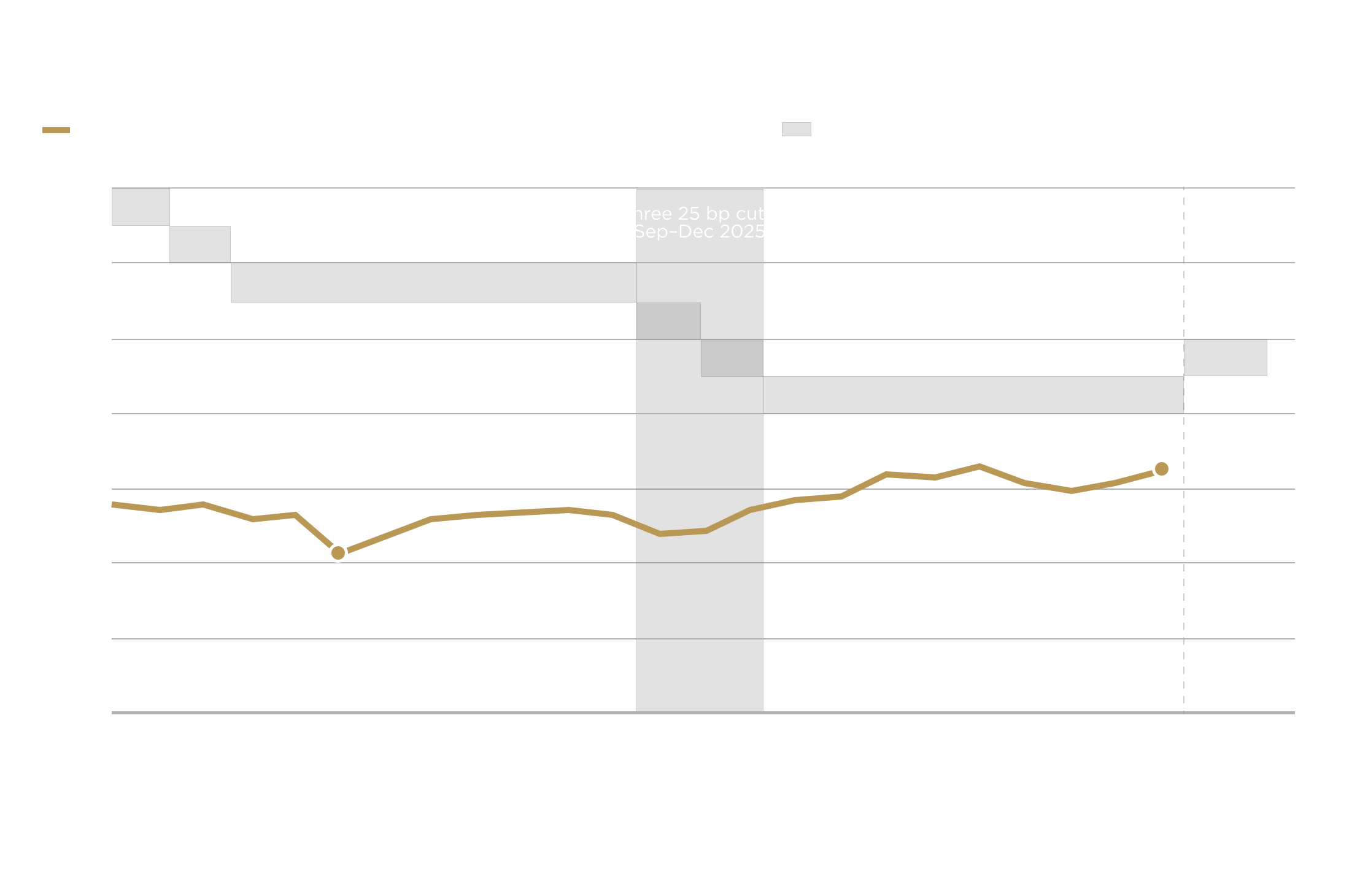
How far, and how soon?
In his speech from November 10 at the Bank of England Watchers Conference in London, Fed Governor Christopher Waller provided an interesting glimpse into at least part of the current thought process at the Fed. Waller voted to hold at the most recent meeting, arguing that markets had already priced in some tightening.[16]
In this speech, however, he stated bluntly that "September's inflation data were bad," and went on to assert that if October's core CPI came in "around 0.3 percent or even higher" (which it did, at 0.3%)[17], a 50 bps hike rather than 25 bps should be considered.[18] He has since gone further, telling CNBC on November 18 that unless the Fed clearly signals another move in January, "you have to go 50 [basis points] in December."[19] None of his colleagues have gone quite so far in public, though the minutes record that "a couple of participants" noted that "an increase of more than 25 basis points could warrant consideration at the next meeting if incoming inflation data were unfavorable."[20] Dallas Fed President Lorie Logan, who is calling for at least two more quarter-point hikes, has said that "it may be possible to move more rapidly this winter than the FOMC has moved so far this fall."[21] New York Fed President John Williams, the committee's vice chair, has taken a more cautious stance, saying on November 17 "I don't think the situation calls for dramatic action."[22]
This view is also defensible. Monetary policy works its way through the system at an unpredictable pace. September's hike may not yet have fully reached the economy. Lower oil prices may well ease inflation in the coming months.
As of November 25, futures markets are almost fully pricing in a quarter-point hike in December, and lean toward a further increase early in the new year.[23] The November jobs report will arrive before the decision, and history has shown that expectations can reverse quickly.
Conclusion
The ever-developing situation in Iran means that near-term predictions are, as Warsh would say, best avoided.[24] What, therefore, should we be watching for?
The low-hire, low-fire phenomenon has been sitting under the positive employment figures for over a year now, and the Fed's own minutes note that labor market dynamism "remained unusually low."[25] Waller, early in his speech quoted above, pointed out that stability alone is not necessarily a sign of health: "If your mom was in the hospital and the doctor told you her condition was stable, you would be relieved but you wouldn't say she is healthy."[26]
The December meeting sees the release of the Fed's new projections for 2027. Treasury yields (as of November 25) stand well above the Fed's current 3.75% to 4.00% range: the two-year at 4.61%, the ten-year at 4.85%.[27] Futures markets, for their part, price in more than one further quarter-point hike by the end of April 2027.[28] The Fed’s new projections could push yields higher still, raising financing costs and weighing on valuations, or give them room to ease.
Warsh believes the Fed can bring inflation down without having to "throw people out of work."[29] But if the Fed is forced to administer stronger medicine sooner than it expects, the patient might turn out to be more fragile than the current robust numbers suggest.
[8] Bureau of Economic Analysis; CNBC; Bureau of Economic Analysis
[9] Bureau of Economic Analysis; Bureau of Economic Analysis
[10] Bureau of Economic Analysis; Bureau of Economic Analysis
[11] Bureau of Labor Statistics; 24/7 Wall St.
[12] Bureau of Labor Statistics
[13] U.S. Energy Information Administration; New York Times
[17] Bureau of Labor Statistics
[21] Federal Reserve Bank of Dallas


