
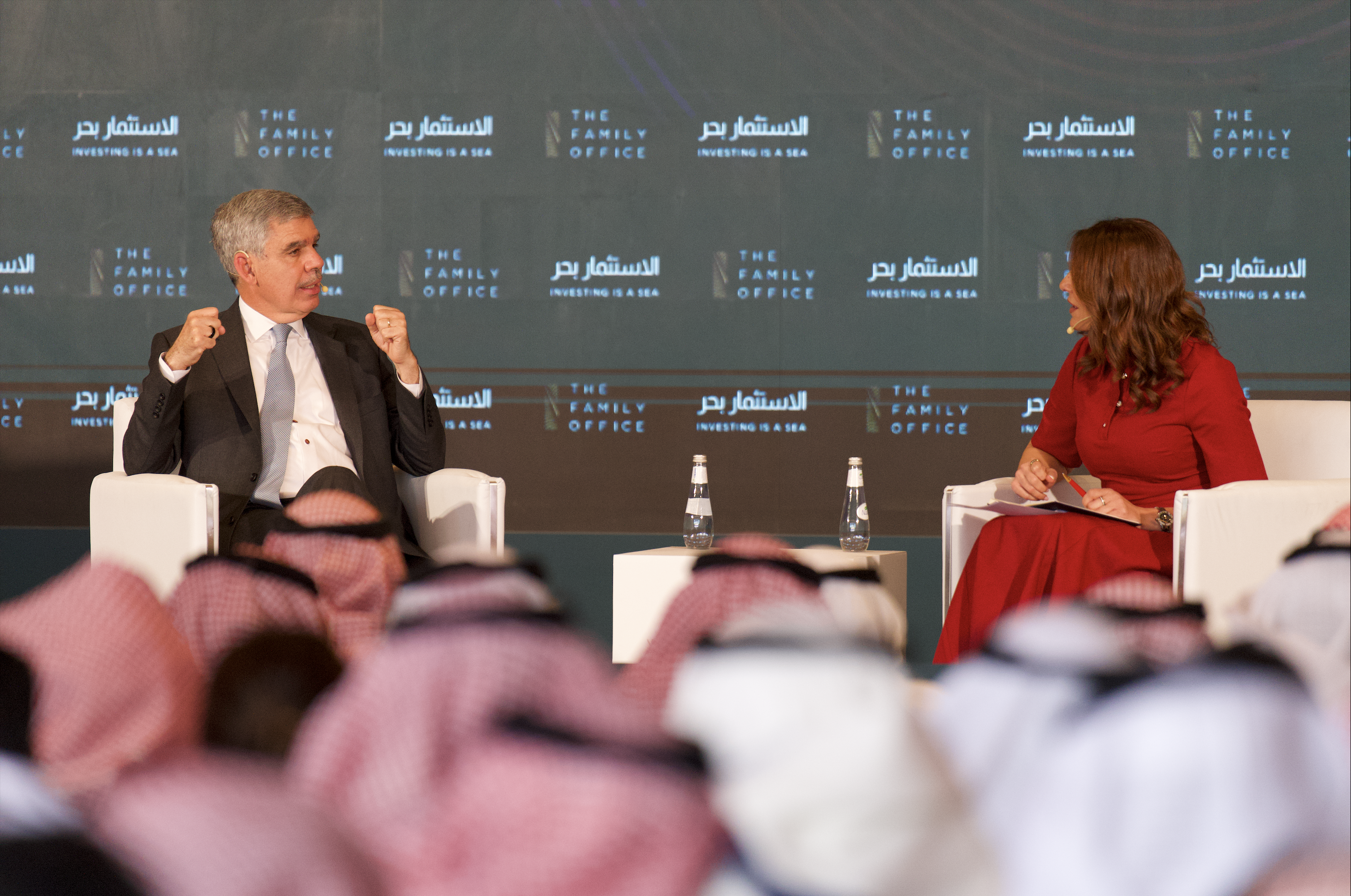
As Abdulmohsin Al Omran, Founder and CEO of The Family Office, noted, investing today resembles navigating the sea. Opportunities are vast, but success depends on clarity of vision, discipline, and the ability to understand the underlying currents of the global economy. Within that context, Dr. Mohamed El-Erian, Chairman of Gramercy Fund Management, offered a framework for understanding the unusual dynamics shaping the global outlook.
His main message was that the global economy is moving into what he described as a “geoeconomic world order”, where economic outcomes are increasingly shaped not only by traditional market forces but also by geopolitics, national security considerations, and domestic political priorities.
The Paradox of 2025
The starting point is a clear contradiction. The past year felt highly unstable, yet economic and market outcomes were strong.
Markets navigated a constant flow of geopolitical and policy-driven developments. Trade tensions, tariff discussions, and shifting alliances dominated the global conversation. At the same time, two pillars that once anchored the global economic system began to weaken: globalization and the policy framework often referred to as the Washington Consensus.
Despite this turbulent backdrop, the results were unexpectedly resilient. Global growth remained solid at around 3.3%, the United States continued expanding at 2.4%, and emerging markets recorded growth of approximately 4.4%. Financial markets also delivered strong returns, with global equities rising by roughly 21%.
Two powerful forces helped explain this resilience. The first was a surge in investment linked to artificial intelligence, as companies and investors accelerated capital spending around AI technologies. The second was China’s ability to redirect trade flows, expanding exports to other markets even as shipments to the United States declined.
Together, these two drivers helped sustain economic momentum despite the broader uncertainty surrounding geopolitics and policy.
Entering a Multimodal Distribution
Looking ahead to 2026, the forecasting environment has changed in an important way. The global economy no longer appears to follow a single dominant path. Instead, several plausible outcomes exist simultaneously.
Economists describe this type of environment as a “multimodal distribution”, where different scenarios carry meaningful probability rather than one central outcome dominating expectations.
The baseline scenario, representing a continuation of current conditions, carries roughly a 50 percent probability. Alongside it sit two tail risks, each with about 25 percent probability.
The positive scenario centers on faster and broader AI adoption, which could lift productivity and allow the global economy to manage challenges such as high debt levels, protectionism, and pressure on central banks.
The negative scenario reflects the risk of stagflation, where economic growth slows while inflation rises, creating a difficult environment for policymakers and investors alike.
A distribution where the central case holds only half the probability is unusual. With both positive and negative outcomes carrying significant weight, uncertainty becomes more pronounced and investors must be prepared for a wider range of possibilities.
Volatility, Dispersion, and Fragmentation
In El-Erian’s view, this environment leads to three defining features for markets in the period ahead: volatility, dispersion, and fragmentation.
Volatility is likely to remain elevated, as markets respond to frequent and often sudden news related to geopolitics, trade policy, technological developments, and domestic political decisions. These sharp, news-driven price movements can easily push investors toward reactive decisions if portfolios are not properly structured.
Volatility, in turn, contributes to greater dispersion across markets. As policy decisions, geopolitical developments, and economic conditions diverge, the gap between winners and losers across countries, sectors, and companies is likely to widen. What economists often describe as a “K-shaped” pattern may become more pronounced, with some parts of the economy accelerating while others lag behind.
At the same time, the global economic system itself is becoming more fragmented. Trade relationships are being rewired, supply chains are shifting, and geopolitical considerations are increasingly influencing investment flows.
Together, these forces are reshaping the investment landscape in ways that require a different approach to portfolio construction.
A Shift in Sources of Return
In a fragmented and volatile environment, the sources of investment returns also evolve.
In recent years, many investors benefited from strong secular themes, such as the rapid rise of AI and technological transformation. These long-term trends generated significant returns across markets.
Looking ahead, however, these secular themes may play a less dominant role in driving returns. Instead, two other sources of returns are likely to gain importance.
The first comes from structural opportunities, where investors are compensated for addressing gaps or inefficiencies in markets. Private credit in emerging markets illustrates this dynamic. Many emerging economies today sit where advanced markets were more than a decade ago, with strong companies seeking financing while traditional lenders retreat. Providing capital in these situations can generate attractive returns while supporting the development of local capital ecosystems.
The second source comes from opportunistic investments. Periods of volatility often create temporary dislocations, where asset prices move beyond their fundamentals. Investors with liquidity and flexibility can step in and capture attractive opportunities.
As a result, portfolios may increasingly combine structural opportunities with the flexibility to capture opportunistic investments when markets overshoot.
The Importance of Execution
In a world where outcomes are less predictable, investment success depends less on forecasting the future with precision and more on the ability to execute effectively across multiple scenarios.
El-Erian emphasized three characteristics that become essential in such an environment.
Resilience ensures that mistakes remain manageable rather than catastrophic, allowing portfolios to recover from unexpected outcomes.
Optionality requires maintaining flexibility and an open mindset, recognizing that the global economy is evolving in ways that are not always predictable.
Agility allows investors to move quickly when opportunities emerge, particularly during periods of market dislocation.
Equally important is the discipline of scenario planning. Investors should consider multiple possible outcomes in advance and determine how portfolios would respond to each scenario before markets force decisions under pressure.
In an environment defined by volatility and dispersion, the ability to identify the right opportunities also increasingly depends on manager selection. As gaps widen between winners and losers across sectors and markets, selecting managers with strong expertise, disciplined processes, and the ability to navigate complex environments becomes a key driver of investment outcomes.
Navigating the Path Ahead
The global economy is moving through a complex transition. Geopolitical shifts, technological transformation, and evolving policy priorities are reshaping the investment landscape.
For investors, the challenge is not simply forecasting the destination of the global economy. As El-Erian noted, the world is likely navigating a bumpy journey toward an outcome that remains uncertain.
Preparing for that journey requires portfolios built with resilience, optionality, and agility, supported by disciplined execution and thoughtful manager selection.
In a world defined by volatility, dispersion, and fragmentation, those principles may prove essential for navigating the sea of global markets.


